 Just Fold Paper
Fold only
Accordion Paper Book
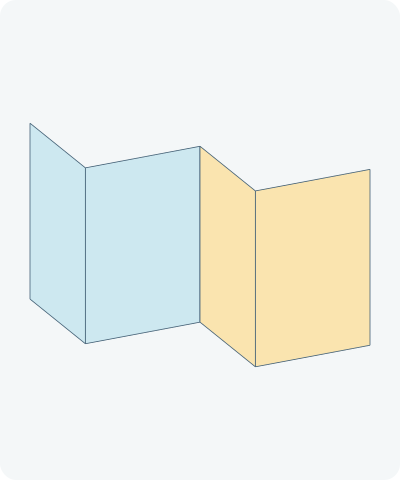
A four-panel, eight-page folded book for pictures or a short story. Follow the moving paper, read every illustrated step or print the one-page guide.
Preparation + 6 numbered steps
Materials
12 × 4.5-inch rectangle · 12 × 4.5 inches
One 12 × 4.5-inch strip (30.48 × 11.43 cm) of paper. Prepare the rectangle before starting; use a ruler and scissors if trimming a larger sheet. Optional pencils or markers. No glue or staples.
Drag to rotate · swipe sideways on touch.
Arrow keys rotate when focused.
Follow along
PreparationThe interactive guide needs JavaScript. Read every illustrated step below.
Help · controls & diagram
Play or drag the progress slider to watch a fold from 0% to 100%. Use the view buttons or drag the diagram to look from another angle.
Blue and gold identify the original left and right halves, not the literal colors of your paper. Darker shades show the reverse. Orange identifies the moving layers and hinge.
With the diagram focused: Space plays or pauses, ←/→ change steps, and Home resets.
Every step, at a glance
Compare your paper with each diagram after completing the action. Blue and gold identify the original left and right halves, not the literal colors of your paper. Darker shades show the reverse. Orange identifies the moving layers and hinge.
- 0. Prepare a long rectangle
- 1. Fold the strip in half
- 2. Fold the front page back
- 3. Fold the back page away
- 4. Open the front cover
- 5. Open the back cover
- 6. Open the center and add a story
PREPARATION · Linked complete construction reference
Prepare a long rectangle
Place the 12-inch edge horizontally. Keep the strip blank for now; add your story after folding.
Layers: One rectangular sheet.
Check: The strip is 12 inches wide and 4.5 inches tall.
Explore this step ↑STEP 1 · Linked complete construction reference
Fold the strip in half
Bring the right short edge across to the left short edge. Line up both corners and press the vertical fold.
Layers: Move the whole right half.
Check: The folded rectangle measures 6 × 4.5 inches.
Explore this step ↑STEP 2 · Linked complete construction reference
Fold the front page back
Take the free left edge of the upper layer and bring it back to the closed right edge. Crease halfway across that upper layer.
Layers: Move only the upper layer; leave the lower half still.
Check: A 3-inch-wide page lies on the right half of the packet.
Explore this step ↑STEP 3 · Linked complete construction reference
Fold the back page away
Fold the free left edge of the lower layer away from you to meet the same closed right edge. Press the fold from the back.
Layers: Move the lower layer only, behind the packet.
Check: All four panels stack into a 3 × 4.5-inch closed book.
Explore this step ↑STEP 4 · Linked complete construction reference
Open the front cover
Lift the front cover halfway back, leaving a right angle at its crease.
Layers: Open the same outer page; keep the other pages together.
Check: The front cover is perpendicular to the next panel.
Explore this step ↑STEP 5 · Linked complete construction reference
Open the back cover
Open the back cover halfway in the opposite direction.
Layers: Move the rear outer page only.
Check: Both covers are partly open on opposite sides.
Explore this step ↑STEP 6 · Linked complete construction reference
Open the center and add a story
Open the middle fold halfway, carrying its cover with it. Look along the top edge: the four panels form a zigzag. Open farther or close it whenever you like. Draw a sequence of pictures across the panels, or use both sides for eight pages.
Layers: Carry the original right half, including its already opened cover.
Check: The complete accordion book opens as one connected strip. There are four panels and eight faces, not eight separate sheets.
Explore this step ↑
Sources & notes
Meghan Burch, The Eric Carle Museum of Picture Book Art, Meghan Burch, The Eric Carle Museum of Picture Book Art: Accordion Paper Book (web tutorial).
The linked publisher documents this construction; it does not identify its original designer. This guide does not claim traditional authorship or a license to reuse the reference photographs or prose. The instructions, diagrams and animation here are independently authored. No reference media is reproduced.
Adaptation: Uses the museum’s single-strip four-panel accordion, without the optional stapled pamphlet variation. The final three openings are shown separately at right angles so every panel remains visible. Four panels have eight writable faces, including the covers. This commonplace bookbinding structure is not attributed as the museum author’s invention.
Original instructions and diagrams, made with AI assistance. About & reuse
Accuracy notes
Real-paper follow-along and paper weight have not been tested. Diagrams illustrate the sequence, not paper thickness, contact, collisions or exact layer visibility. Continuous rigid hinges preserve the original material coordinates, including hidden layers. Display openings and measured shaping landmarks are specified in the instructions. Zero-thickness teaching diagrams do not simulate paper thickness or certify physical foldability. Physical folding and stability have not been tested.